
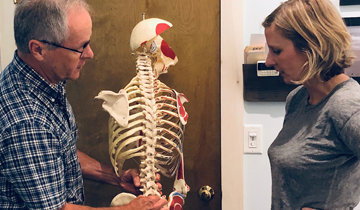
Sacroiliac (SI) joint dysfunction is a condition where the joint connecting the spine to the pelvis becomes misaligned or moves abnormally, often causing pain in the lower back, hip, and joints. Here is a firsthand account for one of our patients journey from impairment to a reclamation of life.
A Pain That Kept Climbing

It started in her mid-40s: a strange sensation in her lower right back, like her hip joint was slipping out of its socket. Pain radiated down her leg to her knee. She assumed it was sciatica. She tried massage therapy locally, which helped a little, but the underlying feeling — that her hip simply wasn’t staying put — never went away.
As the years passed, it got worse. By her mid-50s, the pain had climbed up her back, all the way to her shoulder blades. By the time she reached 65, it had become excruciating.
“I have maybe 20 years to live,” she remembers thinking, “and to be spending each day suffering was starting to cause depression.”
Searching for Answers
She wasn’t someone who ignored a problem — she chased it. She returned to the physical therapist who had helped her years earlier, but this time, after three weeks of massage therapy and exercises, he discharged her, saying he’d done all he could.
Her GP ordered imaging to screen for scoliosis. The results confirmed a low-moderate curvature — unsurprising, given that one of her legs had always been a half-inch shorter than the other. A spine specialist confirmed the childhood scoliosis diagnosis, but when she brought up her SI joint pain, he ordered an MRI of her spine, not her joint. It didn’t help. She left that appointment discouraged, told only to come back if things got worse.
A couple of months later, her GP mentioned she’d heard good things about the physical therapists in Lisbon, and sent a referral to ECRC.
“I was feeling a mixture of hope and skepticism,” she says. “I felt this was my last opportunity for healing, but it probably would not be effective.”
A Different Kind of First Appointment
That skepticism didn’t last long.
During her intake, she described her history, her recent testing, and the everyday tasks that had become painful — meal prep, vacuuming, mopping. What stood out immediately was the depth of knowledge her physical therapist, Sherry, brought to the conversation.
Sherry assessed her spine and SI joint by hand, feeling that the joint wasn’t sitting flat — it was tilted, a direct result of her spinal curvature. From there, treatment became precise and personal: guided leg presses to help realign the joint, wall exercises to correct shoulder positioning relative to her spine, and progressive work on a half stability ball to build strength through her back, core, and glutes. Sherry also taught her how to replicate key techniques at home, using pillows to support the same alignment work between sessions.
“Her broad knowledge of scoliosis and sacroiliac joint pain was remarkable,” she says. “She had more knowledge than my orthopedic spine physician and the physical therapist I saw before her.”
The Turning Point
About a month in, something shifted.
The pain started to decrease — and when it did flare up, she had the tools to manage it at home instead of just enduring it.
“I started PT feeling depressed about my pain. This turned to hope when I started therapy, and then elation when I realized that I was getting my life back.”
Life on the Other Side
Today, she describes her evenings — once spent suffering until bedtime — as comfortable and peaceful. Her SI joint, which used to lock up for weeks at a time with no way to reset it, now responds to the exercises Sherry taught her. She’s back to deadlifting. Weeks after finishing formal treatment, her core is stronger than it was on her last day of PT, because the exercises have simply become part of her daily routine.
One moment stands out above the rest: last spring, hauling 20 bags of cedar mulch around her property left her in agony — the kind of task she and her husband had resigned themselves to hiring out in the future. This year, she did the same job without a trace of back pain.
“I felt as if I were ten years younger.”
In Her Own Words
“I had an outstanding experience at ECRC, because of an educated, highly skilled physical therapist, in an atmosphere filled with camaraderie between the staff and patients.”
“Physical therapy is effective when you follow the physical therapist’s instructions and also when you incorporate your treatment plan at home. This is a must. If you approach PT with interest, you will prevail.”
She also points to the atmosphere itself — the way the ECRC staff worked together, supported one another, and made her feel like part of “one big, happy family.”
If You’re Living With Pain You’ve Been Told to Just Manage
Nearly 20 years of searching, three different providers, and one misdiagnosed direction later, this patient found a treatment plan that finally addressed the root of her pain — not just the symptoms.
If chronic back, hip, or joint pain has become something you’ve simply learned to live with, it may be time for a second opinion. Our team at ECRC Physical Therapy takes the time to understand the full picture before building a plan around what your body actually needs.
Ready to get your life back? Schedule your evaluation with ECRC Physical Therapy today.
At ECRC Physical Therapy we are dedicated to helping you achieve your rehabilitation goals. With locations in Lisbon and Dayville, Connecticut, you can contact our Lisbon office at 860.376.2564 or Dayville office at 860.779.0150 to schedule a consultation and take the first step towards a healthier, more mobile you.
Contact Form